
2026 We Rise Fireside Chat
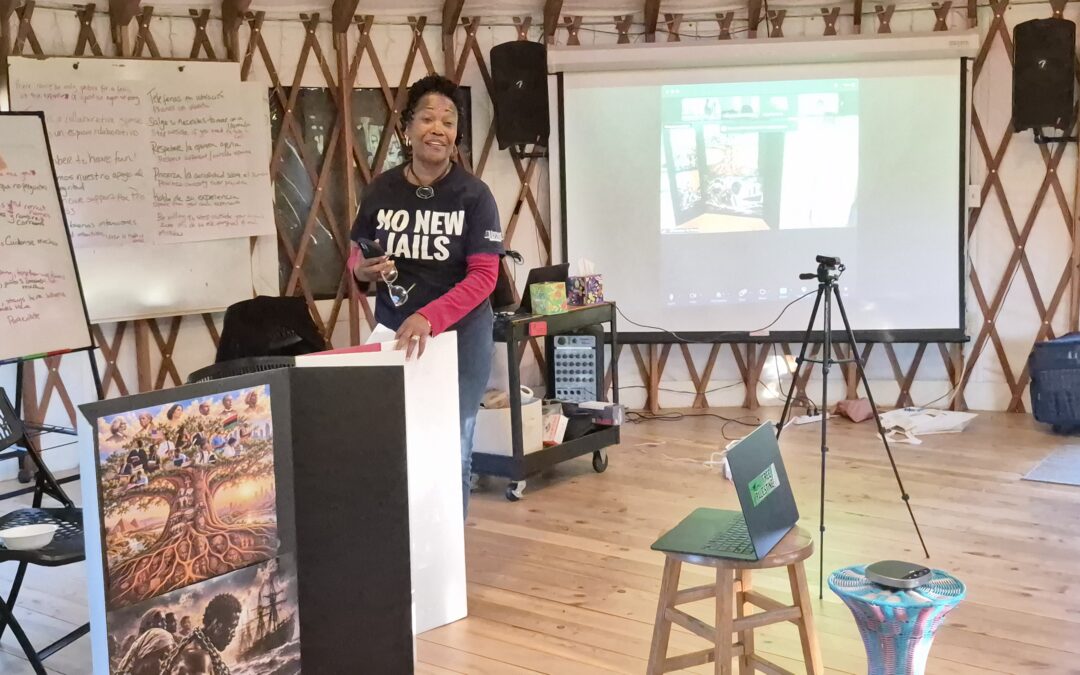
Edwin, a member of FTT’s curriculum team, chatted with Tamu, a recent We Rise Graduate, about their experiences in the leadership program. This interview has been edited for clarity.
Tamu, thank you for graciously giving your time so we could talk about your experience in the We Rise Leadership Program 2026. But for those who don’t know, would you mind sharing a little bit about who you are, what kind of organizing you do, and what attracted you to the We Rise Leadership Program 2026 at Freedom To Thrive?
Thank you for your warm welcome. I have been organizing for about four decades now, and I smile because when asked to talk about myself, I am a little shy. But I’m going to do my best. I’ve been organizing and mobilizing communities since my late teens. And I started doing it because by my early 20s, I had had a variety of challenges to enter into adulthood and it was very devastating. And I didn’t want others to go through that. And so I began doing tenant organizing in my apartment building. And I started organizing around reproductive health with teens, because I was a teen mother and didn’t want some of the challenges and hurdles I had to overcome to be ones for others. And so I did a lot of reproductive health, which led me more into women’s health. So from tenants organizing to reproductive health, and then we had the HIV pandemic in the late 80s (I’m aging myself) when no one knew what it was, and everything was in upheaval and people were literally dying. And so putting the two together and understanding the transmission and how women could protect themselves and how men could protect themselves. I did more around HIV education and I then started my first job in that. So not only was I doing all this civic duty work, right, like around eminent domain in the neighborhood I lived in… it just kept rolling out into more and more issues to address, and it all eventually became very simply anti-poverty work. Would you like me to say more?
Yeah, if I may follow up, you have a lot of experience, but would you share a little bit about your upbringing? Are you from the Boston area? And could you talk about this nationally recognized neighborhood where you did a lot of your tenant organizing? And also, what attracted you now to the 2026 We Rise leadership program at Freedom To Thrive?
Okay, so I am a native Bostonian. And my maternal grandparents came to Massachusetts in 1920 during the Great Migration. They came by way of Virginia to Philly. They went to Philly, and they got married and followed the train tracks and ended up in Everett, which were mostly where the textile mills were. So that’s where the work was. And Massachusetts is very polarized. Black people lived on Beacon Hill at first, but then they were pushed out to other communities like Roxbury. So Roxbury was a lot larger than what it is today because it’s been chopped up. The South End wanted to claim parts of it and didn’t want to share the same zip code. So they got their own zip code. But at one point it was this large community,and there weren’t housing developments. There was residential home ownership in the Black community in Boston that never recovered when those houses were overtaken by eminent domain. And so they never recovered, and they were replaced with tenements, housing developments or public housing. So yes, I feel really grounded and ingrained in this soil here in Massachusetts.
I grew up with a single income household; it was my mother. And what’s important about it for me is that women were beginning to do more than just be homemakers. And although black women had always worked, you didn’t really go to school. You just got a job, you took care of the house, and you had a partner. She was able to go to school because there was a shift happening, so she had some college education. And in my family, there’s a lot of organizing. My brother is the president of his union. My mother is in her 80s, and she is the president of her tenants association where she lives and gets involved in the other Main Street meetings, because they’re in Nubian Square. And so there’s high activity there; one of the most active stations in the city is Nubian Square’s bus station.
So I have a long history of organizers in my bloodline, and my attraction to FTT was really about the people I knew who were involved. The work that they were doing was attractive to me. I too worked for Boston Workers Alliance, I collaborated with City Life and other agencies that you know; we all came together to do reform and housing and other issues that were anti-poverty. So once I found out about Freedom To Thrive, I began to look at what the organization was doing. And once I saw the We Rise program, I applied. I didn’t think I was going to get in because I wasn’t sure if it was for new leadership, seasoned leadership, or what the goal was, but I was pleased to know that it was about any spectrum of leadership you were in. And that was great for me to have an opportunity to continue to evolve.
What’s happening today in crimmigration is something that is the same form of all the other things that I told you about. It’s just targeted at Brown people now. Because there are immigrants who are from European countries. They’re not targeted. So it just goes back to the same oppressive experience that I don’t think anyone should have to go through.
Yes, indeed. Grassroots community organizing is definitely in your blood.
I think we’re all happy to be a part of the same circles where we not only talk about our own values, but also get to experience them with other people, and to execute the values that we cherish. We put a spotlight on crimmigration and we went through a big chunk of this year of virtual sessions. We specifically looked at this intersection of the criminal legal system and the immigration system and how technology exacerbates the kind of oppression, the kind of racism, the kind of all the isms that you could think about, that are laser focused and targeted to our communities. It just so happens that today is happening more to the immigrant community, but at some point, we all come from different places.
I wanted to ask if you could talk a little bit about that experience. Not only about the content, but about people that you shared space with who have a different background, different languages, but they have the same concerns and more or less the same goals. Could you share a few thoughts with us about that experience? What was different? What was similar? What was the impact on the way you think, the way you feel, the way you want to be?
That’s a big question. So, crimmigration reminded me, and it was a sad reminder of the stories about racism against Black people during Jim Crow. And I think what was similar at first, were the lies, the rhetoric that would make an unknowing individual who’s never lived in an area with diversity, or who’s never seen diversity itself, would just believe whatever was being said. So I’ve had opportunities to talk to other people from other cultures and say, well, what did you get told? And, you know, we begin to share stories. Fundamentally, we’re social beings, right? And I think crimmigration shows us that by design, they’re not only dehumanizing the individual, but literally cutting up this social connection that we have with each other.
You spoke about connecting with other people. My other question had to do with the content. You know, learning about history, learning about abolition. So, I wanted you to share your experience with the content that you received at We Rise 2026.
So the content, the meat and potatoes are really about, for me, liberation. And human dignity, accountability, solidarity, transformation. Freedom To Thrive shared content that helped individuals understand the truth. We were able to engage with presenters coming in and telling us about their work and their organizations, and having these discussions, the research activities that they presented, and then taking that knowledge and turning it into real-time practices. One example was during Black August, and the information around the maroons and political prisoners. And we were able to join letter writing campaigns. The discussion on Maroon cultures is being utilized in what I’m doing today. Because I am working on a book called The Uncounted. And it’s about identity and transformation in the African diaspora.
You talked about the importance of the human connection where you’re trying to understand each other as people that come from different places in the world who speak different languages, etc. What were the highlights for you of that experience?
It was the highlight of learning all these new things, but also reiterating things that you already knew. And that you’re able to share with the rest of the group, with people who are living very similar experiences, with these systems. It’s saying that white supremacy is well and alive. But you’ve got to have these conversations.
So what were your highlights in terms of being able to have those discussions? At the end of the day, we spoke in general about the dignity of the person.
Well, that’s actually my highlight because when I liberate myself, then I unconsciously give others permission to liberate themselves. And so I can share about that experience of liberation and the issue of incarceration. Those of us who aren’t incarcerated do have an obligation to support the voices who are incarcerated. We have an obligation, those of us who aren’t in detention. We could be at risk of it, but we do still have an obligation to be a voice of the person who is in the detention center. And those obligations are about shaping policies that affect our lives. And the people whose lives are affected need to have a voice in those policies because they impact them.
So you talked about human connection and dignity, and creating safe spaces so that can happen is what I seek to do in any space. But first, I have to have it done with me. And people did that. They gave me a space to tell the things that I felt ashamed of, embarrassed by, confused about, or didn’t really know about. So that the dignity, the transformations happen through Acknowledging and living out I am somebody. Because I know what I have, I know what I come to the table with. I know what I carry. So there’s a good chance you carry it, too. I’m not as different from you as they try to tell me I am. So I hope that answers your question.
We spent a big chunk of the year, for those who don’t know, in sessions over Zoom. And we did learning sessions, and practice sessions. But at the beginning of this month, in October, we had an in-person gathering in New York. And I wonder if you could share what that experience was like after having been with folks in the virtual world, learning, sharing, laughing, to then actually meeting in person. What was that like?
Definitely the excitement of it. It was a confirmation of what we’ve been talking about, the human connection. Because it automatically deepened it. We had a connection virtually; you cannot not have one after spending almost a year together, right? But when we came together, it definitely deepened the human connection and the sense of community among everyone. The solidarity, the care that was offered. And the passion was very clear in the work that we do. It came through very clearly from each of the participants. Although we felt connected virtually, that passion really was loud and in the room. And we were a diversity of the communities we lived in. And I’m not just talking about our cultures, you know, people from Ecuador, Salvador and you know people from the United States. It was something that was deeper and much more sustaining. And also, I left feeling more energized to continue doing what I’m doing. So there was a validation of what I’m doing. And not that I need validation, but it’s sure helpful when you have somebody tend your flame. The in-person was awesome! What an opportunity.
So this is the last question. And again, I want to appreciate what you’ve shared about the work you’ve done, and the possibilities, and our connections, and so I want to ask if you have a message for those who are new to organizing, who have been organizing for a long time, and may be considering joining a future We Rise leadership program. I get very excited about it too. What message do you give to those who are considering this as a new space for our movements?
The first question to ask is, would you like to taste the fruits of your work while you’re tilling the land? At FTT, you could do that. We become reflections of each other’s work. And so I would present We Rise as an opportunity to connect and get grounded with yourself in a way that you can experience while you are still organizing for impact and change and transformation. I would also invite people to take another look at abolition. I love to be able to articulate it in the way I’ve heard others say at times, that abolition is about safety and not about being unsafe. And when we look at it from that perspective, that’s where we get a chance to reimagine the possibilities. Because we didn’t say this is going to happen today, tomorrow, or even next year or decade from now. We said, let’s just start planting the seeds. So I think that is how I would want someone to be invited to the table. Because leadership is about understanding what you are called to do in your purpose. Your challenges can also be turned into leadership skills. But I want to thank you, Edwin, for inviting me to share this reflection about my experience with the We Rise 2026 cohort, which I am a proud graduate of. And I want to let you know that I’m here for the long haul now.
Thank you again, Tamu.


Recent Comments